
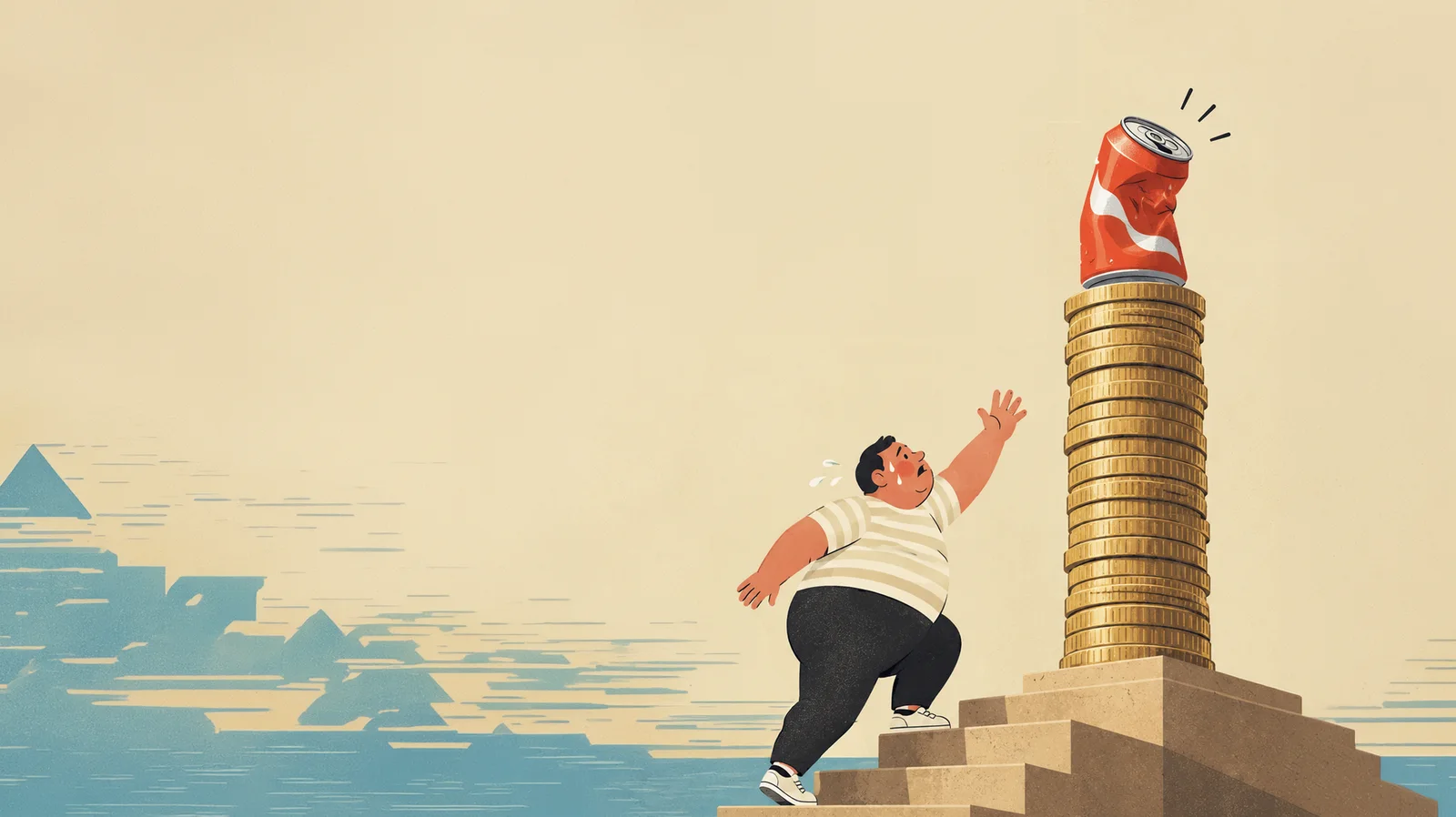
Malta is the EU’s most obese country. Would a fat tax change that?
The best Maltese modelling of a food tax promises a real but modest result, and only if the tax is set high and the subsidy kept small. Denmark’s attempt was scrapped within 15 months. The evidence still points towards taxing, but not towards taxing fat.
In 2025, 26.6% of Maltese adults were obese. The EU figure was 16.3%. Latvia, the next highest in Europe, was two points behind. Italy, an overnight ferry away, recorded 7%.

Taxing unhealthy food is the textbook response, and Malta has a home-grown study to point to. In 2022 Sarah Cassar modelled what different combinations of food taxes and subsidies would do to Maltese waistlines. Her preferred package was a 30% tax on fat and sugar, paired with a 10% subsidy on fruit and vegetables. The result: the share of Maltese who are obese would fall by about 1.6 percentage points, a net 8,000 or so people.
That is the most ambitious package modelled for Malta, and the result is real but modest. It would close about a sixth of the gap with the EU average. It requires a 30% rise in the price of sweets and pastries. And the same model shows that getting the balance between tax and subsidy wrong makes obesity worse.
So the useful question is narrower than whether Malta should tax food. It is which tax would earn its cost, and whether anything else now on the table does better.
What a food tax has to get right
The theory runs in a straight line. A tax raises the shelf price of butter, crisps or fizzy drinks. Shoppers buy less of them. They take in fewer calories. Over several years, average weight falls.
Each step can leak. Shoppers may switch to a cheaper fatty product rather than a healthier one. They may cut back on the taxed item and make up the calories elsewhere. And the people with the most weight to lose are not always the people most willing to change what they buy.
Malta has a further problem, and it sits at the start of the chain. Cassar’s data, drawn from the 2019 European Health Interview Survey, show that obese and normal-weight Maltese report broadly similar diets. Obese men eat as much fruit as normal-weight men. Every group, men and women, obese or not, eats between two and three sweet pastries a week.

If the difference between them is mostly how much they eat and how much they move, a tax on what is in the food works on only part of the problem.
The activity figures support that reading. Only a third of Maltese adults exercise more than three times a week, and just 12% of 15-year-olds manage moderate activity every day. Nearly a third of 15-year-olds are already overweight or obese.
This does not rule out a food tax. Fewer calories in is still fewer calories in. But it means a tax on fat alone was always likely to do less in Malta than its supporters hoped.
What the Maltese model found, and who pays
Cassar’s model takes each adult in the 2019 survey, raises the price of sweets and sweet pastries, cuts the price of fruit and vegetables, and works out how their calorie intake, and over time their weight, would change. How strongly people react to each price is borrowed from studies abroad, because no Maltese estimates exist.
In her central case, a 30% tax with a 10% subsidy, just over a quarter of adults lose more than a kilogram. About 1.7% of the population move from obese to overweight, and as many again from overweight to a healthy weight. Only 0.1% go the other way. The obesity rate falls by about 1.6 percentage points.

Change the mix and the result reverses. With the tax and the subsidy both at 20%, 19% of adults put on weight, 1.1% of the population moves from overweight to obese, and the obesity rate rises by about a point. The reason sits in the borrowed numbers. Shoppers respond more to cheaper fruit and vegetables than to dearer sweets, and fruit has calories too. A generous subsidy adds more to the plate than the tax takes off.
The danger, then, is an oversized subsidy. A 20% tax on its own is a different policy. An earlier University of Malta study, by K. Sant in 2019, modelled a 20% tax on sugary drinks alone and found that around 40% of adults would lose some weight.
The finding that matters most for the politics runs against the usual objection. Food taxes are regressive: a poorer household spends more of its budget on food, so it pays a larger share of its income in tax. Cassar uses education as a stand-in for income, and in her model the least educated gain the most. A third of them lose more than a kilogram, against a sixth of the most educated.

The tax takes more from poorer households and does more for their health. Both are true. A government that wants the second has to answer the first, which is what the subsidy and the use of the revenue are for.
The cautions are real. The price responses come from other countries. Weight and height in the survey are self-reported, and people tend to understate their weight. Change the assumptions and the result moves a long way. With price responses that vary by income, around 30,000 people, 5.8% of the population, move out of obesity, more than three times the central case. The 20% and 20% scenarios do worse. The 1.6-point figure is a middle estimate, and a modelled one.
Denmark taxed the shopper. Britain taxed the recipe itself.
Denmark is the only country to have tried a fat tax at national level. From October 2011 it charged 16 kroner, a little over €2, per kilogram of saturated fat in any food containing more than 2.3% of it. Butter, cheese, pizza and processed meat all went up.
Sales of the twelve food groups it targeted fell by 0.9%. A 2015 study of retail data could not even agree on the sign of the health effect: one method suggested heart disease risk rose by 0.2%, another that it fell by 0.3%. Shoppers moved between fatty products rather than away from them, and many simply drove to Germany. The tax was abolished in January 2013.
Malta would avoid the second problem. Nobody drives to Sicily for cheaper cheese. The first problem would travel well, because it comes from the design. A tax on a nutrient spreads a small price rise across hundreds of products and leaves the shopper to work out what to do about it.
Britain’s Soft Drinks Industry Levy, introduced in April 2018, did the opposite. It taxed manufacturers, not shoppers, and charged more for drinks with more sugar. Most companies cut the sugar before the levy started so they would not have to pay it. Cambridge researchers later estimated an 8% fall in obesity among girls in their last year of primary school, about 5,000 cases a year, rising to 9% in poorer areas. They found no effect among boys.
The difference lies in what was taxed. Sugary drinks are the one category where the evidence for a price effect is strong. A 2022 review of 86 studies found that sales of taxed drinks fell after taxes were introduced, and the World Health Organization recommends a tax that raises their shelf price by at least 20%. A levy tiered by sugar adds a second effect: it pushes manufacturers to change the recipe, which cuts sugar even for people who keep buying the same can. Denmark taxed a nutrient spread across hundreds of foods, where the evidence is thin and switching is easy.
There is a Maltese complication. Malta imports most of what it eats and drinks, and a market of half a million people will not persuade a multinational to change a recipe. Much of what is sold here is made for larger markets, some of them already covered by sugar levies. A Maltese levy would have to work mainly through price. For drinks, that is where the evidence is strongest.
The new option is a jab, and it does not scale
Two things have changed since the debate last surfaced. The numbers have not moved, and a medical alternative has arrived.
Malta’s adult obesity rate has hovered around 26% since 2014, peaking at 28.7% in 2019. It has been the highest in the EU in every Eurostat survey since 2008. Whatever has been tried has held the line at best.

The alternative is the new class of weight-loss drugs, such as Ozempic, Wegovy and Mounjaro. They suppress appetite and, in trials, produce far larger losses than any tax. In April the government announced €5 million to supply them free to 2,000 people with type 2 diabetes and a BMI of 40 or more, with a later phase planned for a BMI of 35. The brand was still out to tender.
If the €5 million covers a year of treatment, that is about €2,500 a patient. On Spunt’s estimate from population figures, roughly 120,000 Maltese adults are obese. The programme reaches under 2% of them. Extending it to all of them at the same price would cost around €300 million a year, against total health spending of about €2 billion.
Prices will fall when cheaper generic versions reach Europe, but not soon enough to change that sum this decade. Drugs are a treatment for the people already at the far end of the problem. They do nothing for the 15-year-olds now heading towards it.
The cost of doing nothing gives the scale. A 2017 study by Malta’s health ministry and international partners projected that obesity-related illness would cost the health service €43.6 million a year by 2035 if trends continued. A 5% fall in average BMI would save about €141 million over the same period. A tax that raised revenue while nudging weight down by even a point or two would pay its way on those terms. A drug programme at scale would not.
A levy, not a fat tax
The case made for a fat tax was that Malta’s diet is killing it and a price signal would fix the diet. The evidence supports the first half. For fat, it is weak on the second. Denmark’s fat tax moved sales by under 1%, and the best Maltese model of a heavier package cuts the obesity rate by about 1.6 points, at the price of a 30% rise in the cost of sweets and pastries.
Malta should still tax, because nothing else on offer reaches the whole population at a price the state can carry. But the tax worth having looks like Britain’s, not Denmark’s: a levy on manufacturers and importers of sugary drinks and a short list of high-calorie products, steeper as the sugar rises, with the money returned visibly to lower-income households and school food, and any subsidy on fruit and vegetables kept well below the tax. It should be set high enough to matter. The WHO benchmark is a 20% rise in the shelf price, and the Maltese modelling warns that a subsidy as large as the tax can backfire.
Expect a point or two off the obesity rate, not ten. That is a modest return, and on the health ministry’s own cost projections a worthwhile one.
What cannot yet be answered is how much Maltese households actually buy of what. There is no public data on grocery purchases by income here, which is the evidence any tax would need to be designed and later judged against. Collecting it costs little, and it would settle most of this argument before the first euro is levied.
Sources
-
Eurostat, Obesity rate in the EU: 16.3% in 2025, 4 September 2026 (P)
-
OECD and European Observatory on Health Systems and Policies, Malta: Country Health Profile 2025 (P)
-
M. Bødker, C. Pisinger, U. Toft and T. Jørgensen, The Danish fat tax: effects on consumption patterns and risk of ischaemic heart disease, Preventive Medicine, 2015 (P)
-
University of Cambridge, Sugary drinks tax may have prevented over 5,000 cases of obesity a year in year six girls alone, on Rogers et al., PLOS Medicine, January 2023 (S)
-
D. Cauchi, L. Webber, C. Knai, D. Gauci, Z. Chalabi and N. Calleja, Health and economic consequences of projected obesity trends in Malta, Public Health Panorama, 2017 (P)
-
The Malta Post, Malta announces free weight-loss drug programme, April 2026 (S)
-
S. Cassar, Analyzing the Potential Impact of Food Taxes and Subsidies on Obesity in Malta, M.Sc. Economics dissertation, University of Malta, September 2022. Modelled estimates; charts redrawn from its figures 3, 5 and 9 and table 21 (P)
-
V. di Cosmo and S. Tiezzi, Fat vs. Sugar: The Case for a Saturated Fat Tax in Italy, Health Economics, 2025. Cited in the original carousel; not consulted for this piece
The WHO 20% benchmark (Guideline on fiscal policies to promote healthy diets, 2024) and the 86-study review (Andreyeva et al., JAMA Network Open, 2022) are as cited in Spunt’s fact check of Dr Mariella Borg Buontempo’s sugar tax claim.
K. Sant, The potential economic impact of a sugar-sweetened beverage tax in Malta, University of Malta, 2019, as summarised in Cassar (2022). Country figures and the Malta trend: Eurostat dataset sdg_02_10.
Spunt estimates: adult obese population (about 120,000) from Eurostat’s 2025 rate applied to Malta’s adult population; drug cost per patient and at full coverage from the government’s €5 million and 2,000-patient figures; total health spending from the Country Health Profile’s €3,563 per head.