
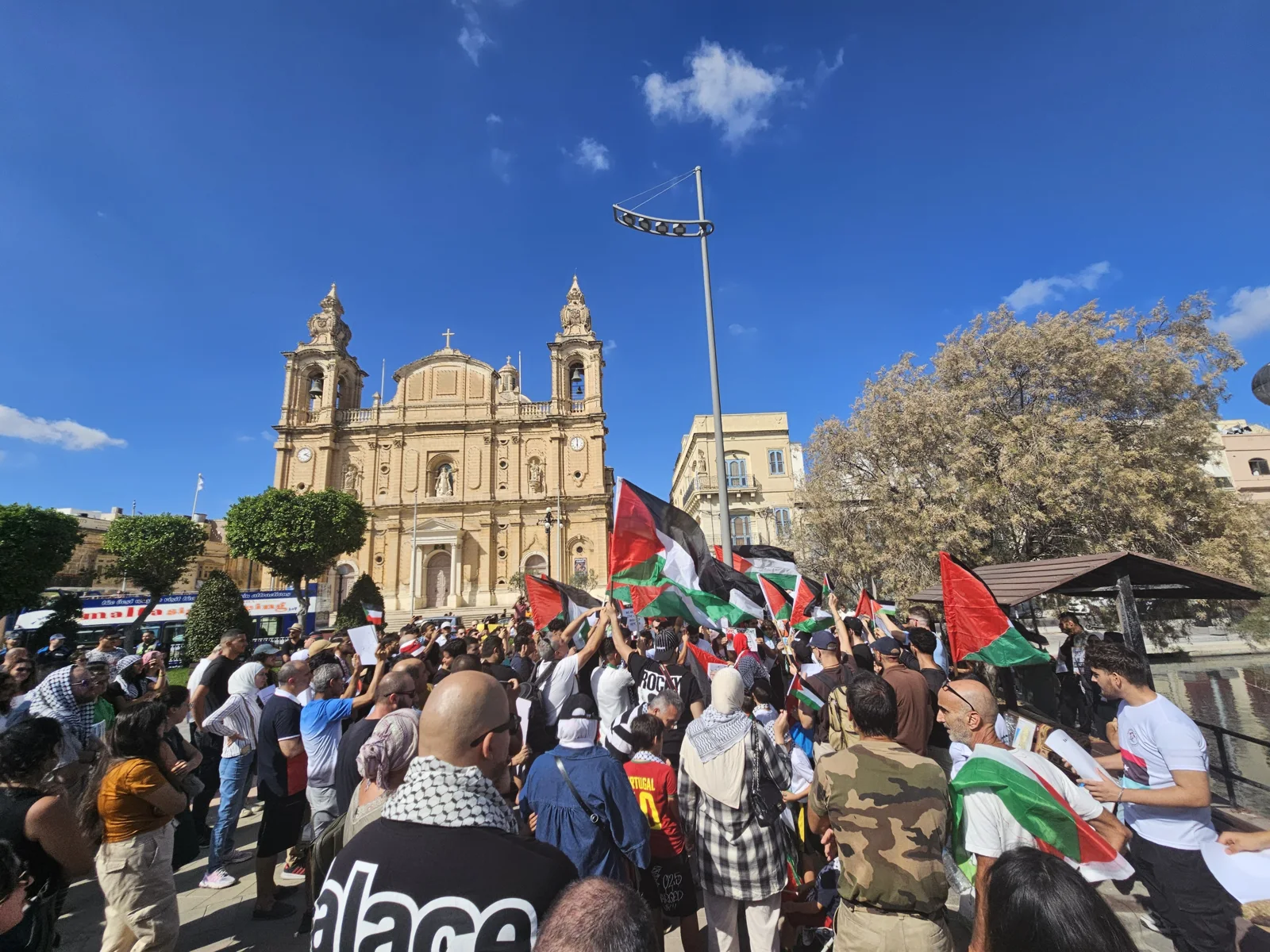
The diplomacy behind Malta’s 1988 stand on Palestine
On 16 November 1988, Malta welcomed the Palestinian declaration of independence. But the story behind that decision began years earlier, through diplomatic meetings, contacts with Arab governments and a foreign policy that survived a change in government.
On 16 November 1988, the Maltese government issued a statement welcoming the Palestinian declaration of independence, which had been proclaimed in Algiers the previous day.
Malta reaffirmed its recognition of the Palestinian people’s right to establish their own state and described the declaration as an opportunity to reach a negotiated peace settlement.
It was an important moment in Malta’s relationship with Palestine. But the decision was not made in isolation. It followed years of diplomatic engagement that began when Malta was establishing its identity as an independent country.
Much of that history is usually told through official declarations and visits. However, declassified American diplomatic cables offer an additional perspective on how Malta’s relationship with Palestinian representatives developed, including discussions that took place away from public attention.
When Malta began opening doors to the Palestinians
During the early 1970s, Prime Minister Dom Mintoff was reshaping Malta’s international relationships.
Malta had gained independence in 1964, but British military facilities remained on the island. Mintoff wanted to reduce dependence on Western powers, establish closer relationships with countries outside the Western bloc and strengthen Malta’s position in the Mediterranean.
Relationships with Arab countries were part of this strategy. They offered political cooperation, potential economic opportunities and support for Malta’s efforts to establish a more independent foreign policy.
The Palestinian question became part of these wider relationships.
At the time, the Palestine Liberation Organisation (PLO), led by Yasser Arafat, was seeking international recognition as the representative of the Palestinian people. The organisation was involved in armed struggle against Israel, and many Western governments were reluctant to establish formal diplomatic relationships with it.
Malta took a different approach by opening channels of communication.
One of the earliest documented episodes took place in November 1974, when a small PLO delegation visited Malta at the invitation of the Peace and Solidarity Council.
An American diplomatic cable dated 8 November 1974 identified three visiting Palestinian representatives, accompanied locally by Paul Agius of the council.
The American Embassy reported that the visitors had received considerable newspaper coverage, particularly in publications associated with the Labour movement.
But it also recorded an important detail: there was no known contact between this delegation and Maltese government officials.
At this stage, some of the contacts were taking place through organisations outside government rather than through established diplomatic missions.
That would soon change.
The Palestinian representative who met Mintoff
On 9 April 1975, Nimr Hammad, the PLO’s representative in Italy, arrived in Malta and met Prime Minister Dom Mintoff.
His visit was recorded in an American diplomatic cable sent from Valletta on 11 April.
The main subject attracting attention was the possibility of opening an official PLO representative office in Malta.
The cable reveals that the American Embassy was following the developing relationship closely. It also identifies another country involved in the arrangements: Egypt.
According to the American diplomats, the Egyptian Embassy in Malta had helped organise Hammad’s visit.
This detail offers an insight into the diplomacy surrounding Malta’s early contacts with the Palestinians.
The relationship was not developing solely through direct discussions between Malta and the PLO. Egyptian diplomats were also helping to facilitate communication.
The American Embassy was uncertain about the precise status of Malta’s relationship with the organisation.
Although the pro-Labour newspaper Malta News reported that Mintoff’s government had recognised the PLO soon after taking office in 1971, the American diplomats said that they could not confirm when formal recognition had occurred.
Even Malta’s Foreign Ministry, according to the cable, could not provide them with a confirmed date.
This illustrates an important distinction between political support, diplomatic contact and formal recognition. The relationship was developing, but not every step had been publicly or formally documented.
What a confidential conversation revealed
The discussions continued.
Hammad returned to Malta on 15 and 16 May 1975, speaking publicly about the Palestinian question and the proposed representative office.
He expressed hope that the office would open shortly.
However, a confidential American diplomatic cable dated 22 May 1975 reveals a different assessment being communicated privately.
The Egyptian chargé d’affaires in Malta, Samir Mohamed Kamel, had spoken to the American ambassador the previous day.
According to the cable, Kamel believed the PLO had already achieved what it wanted from its contacts with Malta: permission to open an office and the publicity surrounding that decision.
He suggested that the organisation might therefore decide against actually establishing a physical office on the island.
The American Embassy considered his assessment credible because of the Egyptian Embassy’s close relationship with Hammad.
This was an Egyptian diplomat’s assessment, as reported by the Americans, rather than a confirmed statement of PLO intentions. Nevertheless, it shows that the diplomatic significance of an office was being discussed even before its physical establishment.
In the end, the prediction proved incorrect.
In 1979, the PLO established its representative office in Malta, with Mourad Essa Bahloul becoming its first representative.
The contacts of the preceding years had developed into a permanent diplomatic presence.
Why Malta’s involvement extended beyond bilateral relations
Malta’s support for Palestinian rights was not confined to direct relationships with the PLO.
In 1975, the United Nations established the Committee on the Exercise of the Inalienable Rights of the Palestinian People.
Malta became its Rapporteur, giving the country a continuing role in preparing and presenting the committee’s work.
This was significant for a small state.
Through the committee, Malta could participate in international discussions on Palestinian self-determination and help keep the question on the United Nations agenda.
The involvement continued into the 1980s.
In April 1982, Malta hosted the Sixth United Nations Seminar on the Question of Palestine at the Mediterranean Conference Centre in Valletta.
The meeting brought together international representatives and experts to discuss Palestinian rights and the possibility of a political settlement.
Foreign Minister Alex Sceberras Trigona addressed the gathering, while Maltese diplomat Victor J. Gauci served as the seminar’s Rapporteur.
The meeting concluded with the Valletta Appeal to Western Europe for Justice in Palestine, which called for greater European involvement in securing Palestinian rights.
Malta was therefore doing more than expressing support from a distance. It was participating in the international structures through which Palestinian diplomatic demands were being discussed and promoted.
These activities helped establish a relationship that extended beyond the personalities of individual political leaders.
A change of government, but not a reversal of policy
In May 1987, Malta elected a Nationalist government led by Eddie Fenech Adami.
The change brought a different approach to foreign policy. The new administration sought to rebuild relations with Western countries and pursue closer integration with Europe.
Censu Tabone became Minister for Foreign Affairs.
Given the close relationships Mintoff had developed with Arab governments, the change in administration raised a question about whether Malta would maintain its previous position towards Palestine.
The events of November 1988 provided an answer.
On 15 November, the Palestinian National Council, meeting in Algiers, proclaimed the establishment of an independent Palestinian state.
The declaration came during the First Intifada, which had begun in December 1987. It was accompanied by a political programme that endorsed UN Security Council Resolutions 242 and 338 as the basis for an international peace process.
These resolutions concerned the settlement of the Arab-Israeli conflict, including Israeli withdrawal from territories occupied in 1967, negotiations and the security of states in the region.
For Malta, the Palestinian decision represented an opportunity for renewed negotiations.
On 16 November 1988, Fenech Adami’s government issued its statement reaffirming the Palestinians’ right to a state and welcoming their declaration of independence.
The statement was subsequently transmitted to the United Nations by Malta’s Permanent Representative, Alexander Borg Olivier, in a letter dated 28 November 1988.
The government’s response was consistent with Malta’s longstanding support for Palestinian self-determination, but it also placed explicit emphasis on peaceful negotiations.
Later that month, in a message marking the International Day of Solidarity with the Palestinian People, Fenech Adami reaffirmed Malta’s commitment to the UN Committee on Palestinian Rights and called for an international peace conference.
The policy established during the 1970s had survived a major change in Malta’s government and international orientation.
What did Malta actually recognise in 1988?
There is an important distinction between the events of 1988 and Malta’s eventual formal recognition of the State of Palestine.
The statement of 16 November 1988 reaffirmed the Palestinian people’s right to establish a state and welcomed their declaration of independence.
It did not amount to the same diplomatic step as Malta’s formal recognition of the State of Palestine on 22 September 2025.
The distinction matters when interpreting the history.
The events of 1988 were part of a longer process in which Malta supported Palestinian national rights while advocating a negotiated settlement of the conflict.
The full internal discussions behind the Maltese government’s November 1988 statement have not been established by the diplomatic records examined here.
However, the earlier cables reveal how relationships were cultivated through visiting representatives, contacts facilitated by Egyptian diplomats, discussions about representation and sustained involvement in the United Nations.
These developments help explain why Malta was positioned to respond so quickly when the Palestinian declaration was announced.
The significance of 16 November 1988 lies not only in what Malta said that day, but in the diplomatic relationship that had been built over the preceding years.
It was a relationship shaped under Mintoff, maintained under Fenech Adami and eventually followed by formal recognition of Palestinian statehood in 2025.