
In a world full of AI, people still prefer the personal touch to feel safe
Malta has one of the best digital governments in Europe. Yet more people than ever pick up the phone to ask the state for help. The reasons tell us how the country has changed.
Malta came first in the European Commission’s 2024 ranking of digital government, with a score of 97 out of 100. The EU average was 76. Most adults use these services. In 2025, 78 per cent of people aged 16 to 74 used an online government service, according to the NSO.
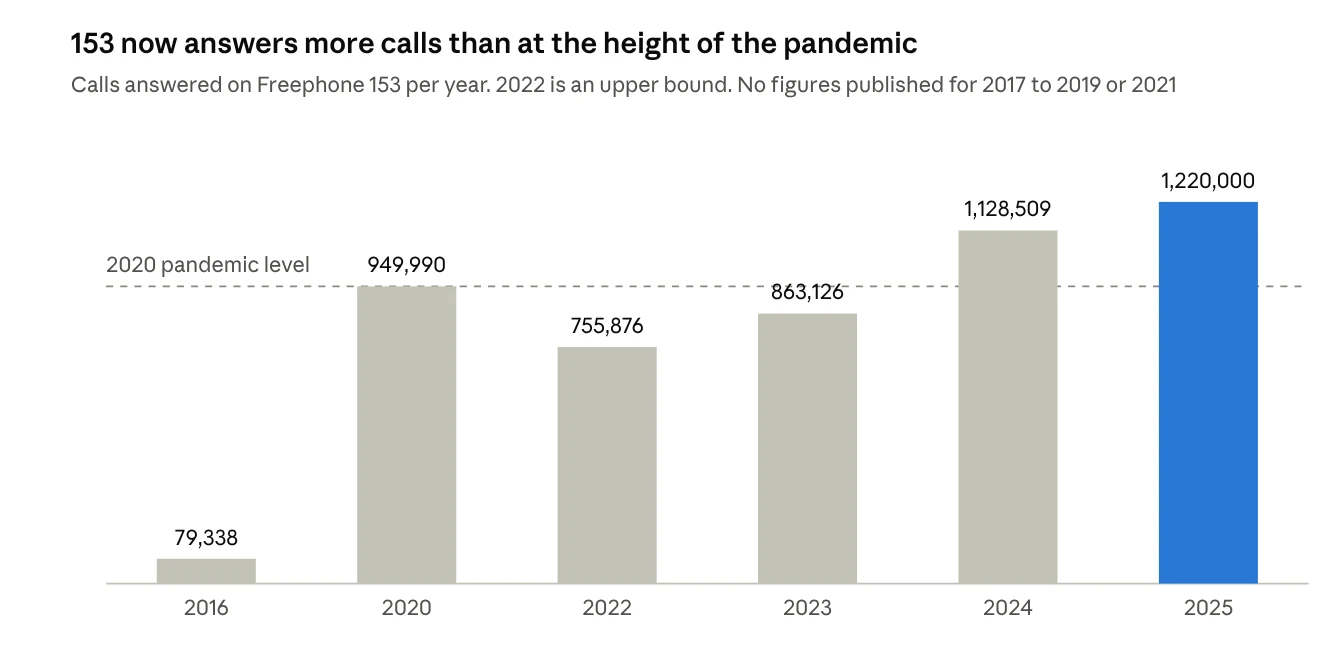
So you might expect fewer people to need help from a person. The opposite has happened. In 2025 the government’s free helpline, 153, answered about 1.22 million calls. That is 3,342 calls a day. In 2016, its first full year, it answered 79,338.
Servizz.gov turns ten this year, and its figures are a useful record of how people in Malta deal with the state. Read closely, they say less about technology than about the people using it.
What Servizz.gov does
Servizz.gov is the government’s one-stop shop. It does not decide on benefits or permits itself. It helps people deal with the ministries and agencies that do. It answers questions, helps with forms and books appointments. People can reach it in five ways: by phone on 153, at 25 regional centres, on the servizz.gov.mt website, through a chatbot, or by email.
| Channel | 2023 | 2024 | 2025 | Change 2023 to 2025 |
|---|---|---|---|---|
| Freephone 153 (calls) | 863,126 | 1,128,509 | c. 1,220,000 | +41% |
| Regional centres (visits) | 287,580 | 332,015 | c. 350,000 | +22% |
| 86,192 | 107,115 | c. 131,000 | +52% | |
| Chatbot and live chat (unique users) | 61,560 | 75,760 | 79,903 | +30% |
| Portal (unique users) | 898,563 | 977,380 | 736,800 | -18% |
| Helpline 138 (calls) | not counted | not counted | 40,276 | new |
| Total | 2.20 million | 2.62 million | 2.56 million |
Source: Servizz.gov annual reports for 2023, 2024 and 2025. 2025 figures for calls, visits and email are rounded in the report. Totals and percentage changes are this desk’s calculation.
These channels fall into two groups. On the phone, at a centre or by email, a person deals with you. On the website, and mostly on the chatbot, you serve yourself. In 2023 Servizz.gov said its chatbot solved 60 per cent of cases without a member of staff.
In 2023, 56 per cent of all contact went through a person. By 2025 it was 68 per cent. This calculation is ours.
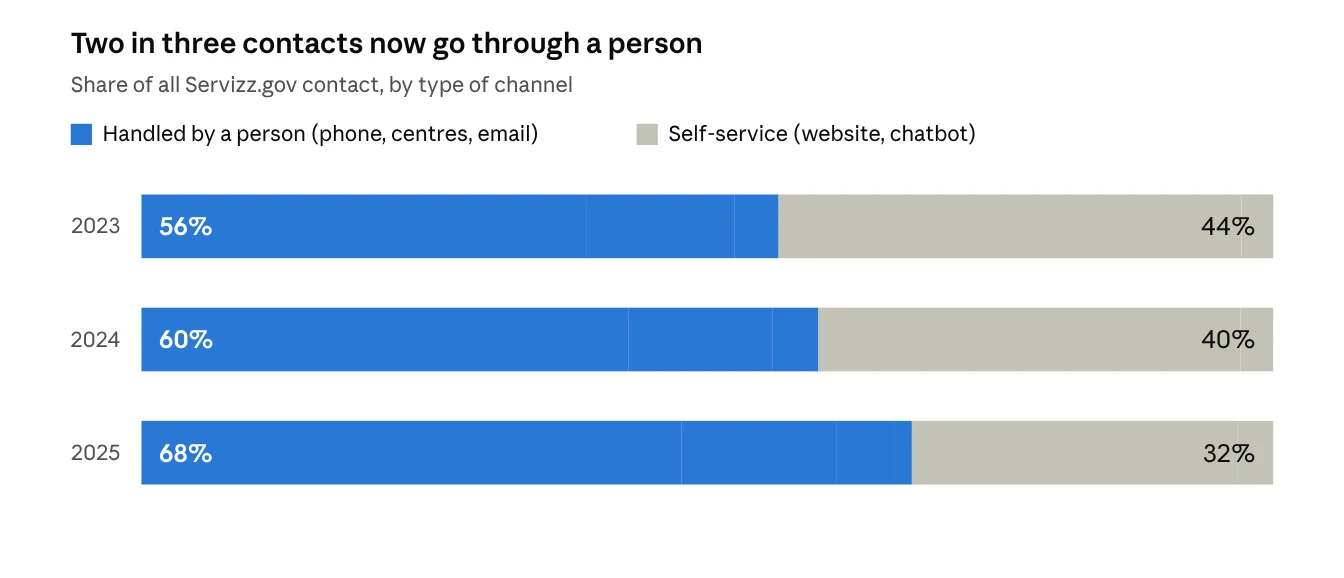
Every channel with a person in it grew. The website was the only one that shrank.
What this says about Malta today
More people know the number
Malta’s population grew from 542,051 at the end of 2022 to 588,254 at the end of 2025, according to the NSO. That is a rise of 8.5 per cent in three years. Over the same years, calls to 153 rose by about 61 per cent. In 2022 there were about 1.4 calls for every resident. In 2025 there were 2.1.
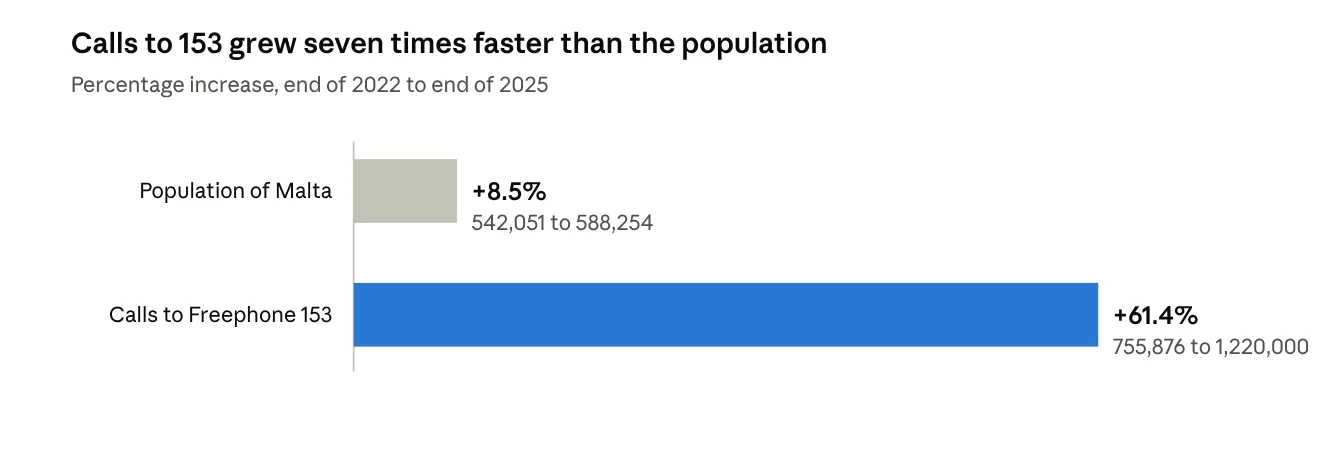
So a bigger population explains only a small part. The timing points somewhere else. The biggest jump came in 2024, when calls rose by 31 per cent in one year. Population growth, at under 3 per cent a year, cannot produce a jump that size.
2024 was the year Servizz.gov changed its image. It relaunched its brand in April and began running regular information campaigns. In October it ran a campaign about the 153 number itself, showing it on car number plates and front doors, with the message that the freephone can help with many parts of daily life. Its annual report says its reach on Facebook more than doubled that year, and its audience on Instagram tripled. A campaign does not prove that people called because of it. But people cannot use a number they do not know, and the largest rise in calls came in the same year as the largest push to make the number known.
Migration may add to this, but the evidence for it is weaker. At the end of 2025, 31.1 per cent of people living in Malta were not Maltese citizens, and a newcomer dealing with tax, social security and an ID card has good reason to call. But the population grew gradually, while calls jumped in a single year. Servizz.gov also does not record who calls, so the data cannot show how much of the growth comes from Maltese users and how much from newcomers.
Online to find out, a person to act
The second change is in how people use the state. The services people asked about most in 2025 were social benefits, including children’s allowance, retirement pensions, tax forms, sending in medical certificates and registering for an e-ID. Almost all of these can be done online. All of them involve money or legal status, and a mistake can cost you.
Research on how people choose between government channels helps explain this. A study of Dutch citizens by Ebbers, Jansen, Pieterson and van de Wijngaert (2016) found that people do not always choose the most efficient channel. Their choice depends on the task, on their situation and on how they feel. A second study, by Ebbers, Jansen and van Deursen (2016), found that digital skills, more than internet access, decide who can use online government services.
Malta’s numbers fit this. According to the European Commission, 63 per cent of people in Malta have at least basic digital skills. More than a third do not. Among people aged 65 to 74, almost one in four does not use the internet at all, the NSO reports. And 18.4 per cent of residents are now 65 or older.
Self-service also moves work onto the citizen. Madsen, Lindgren and Melin (2022) call the user of an online public service an “accidental caseworker”. When a website replaces the clerk, the citizen does the clerk’s job: finding the right rule, filling in the form and checking it is correct. For a simple task this works. For a pension or a benefit, many people want someone to check with them. The e-ID shows this most clearly. It is the key to Malta’s digital services, and people are asking a person to help them get it.
A habit from the pandemic
Calls to 153 reached 949,990 in 2020, when people needed help with COVID-19 rules and vaccine certificates. After the crisis they fell, to no more than about 756,000 in 2022. Then they grew again, and passed the 2020 level in 2024 with no emergency to push them. Many people may have learned in 2020 that 153 answers, and kept calling. The data fits this but cannot prove it.
What the numbers cannot show
Not all of the growth is new demand. Over ten years, Servizz.gov has taken on work that other departments used to do. It added services and extra lines to 153. From mid-2025 its centres began handing out ID cards, more than 40,000 in the second half of the year. From September 2025 they stayed open longer, adding more than 450 hours of service a month. Some calls and visits that once went elsewhere in government now come to Servizz.gov. The published figures cannot separate the two.
The website is also a puzzle. Visitors to servizz.gov.mt fell by a quarter in 2025, from 977,380 to 736,800, and the annual report does not say why. Yet the NSO found that more people used online government services in 2025 than in 2024. So people did not stop going online. They may have used other government websites, such as MyChild, or the way visits were counted may have changed. We could not confirm either.
This does not change the main finding. If website visitors had stayed at their 2024 level, 62 per cent of contact in 2025 would still have gone through a person, up from 56 per cent in 2023.
It does affect one claim. Servizz.gov’s anniversary material calls 2025’s 2.55 million interactions a record. Its own annual reports show that 2024 was higher, at 2.62 million. 2025 is also the first year to include Helpline 138. Counted the same way, 2025 came to about 2.52 million, around 4 per cent below 2024. All of the fall is the website.
What it adds up to
Ten years ago, the plan was for government to move online. In one sense it has. Malta’s online services are among the best in Europe, and most people use them. But people’s needs have moved in a different direction. More people now know where to ask, and more of them are new to the system. The tasks that matter most are the ones where people want a person to check. They use the screen to find out and the phone to act.
The new servizz.gov.mt, launched in June 2026 with a personal dashboard and an AI assistant, is a bet that self-service can win some of this back. The test is simple. If the share of contact handled by a person falls in 2026 and 2027, the bet is working. One question stays open: how much of the growth on the phone is new demand, and how much is work moved from other parts of government. Servizz.gov holds the data by service that would answer it.
References
-
Ebbers, W.E., Jansen, M.G.M., Pieterson, W.J. and van de Wijngaert, L.A.L. (2016) ‘Facts and feelings: the role of rational and irrational factors in citizens’ channel choices’, Government Information Quarterly, 33(3). doi: 10.1016/j.giq.2016.06.001. Available at: https://research.utwente.nl/en/publications/facts-and-feelings-the-role-of-rational-and-irrational-factors-in/ (Accessed: 6 October 2026).
-
Ebbers, W.E., Jansen, M.G.M. and van Deursen, A.J.A.M. (2016) ‘Impact of the digital divide on e-government: expanding from channel choice to channel usage’, Government Information Quarterly, 33(4), pp. 685-692. doi: 10.1016/j.giq.2016.08.007. Available at: https://research.utwente.nl/en/publications/impact-of-the-digital-divide-on-e-government-expanding-from-chann (Accessed: 6 October 2026).
-
European Commission (2025) Malta 2025 Digital Decade Country Report. Available at: https://digital-strategy.ec.europa.eu/en/factpages/malta-2025-digital-decade-country-report (Accessed: 6 October 2026).
-
Government Transformation Magazine (2024) ‘Malta tops EU eGovernment benchmark, says new report’, 2 July, reporting European Commission, eGovernment Benchmark 2024. Available at: https://www.government-transformation.com/en/citizen-experience/malta-tops-eu-egovernment-benchmark-says-new-report (Accessed: 6 October 2026).
-
Madsen, C.Ø., Lindgren, I. and Melin, U. (2022) ‘The accidental caseworker: how digital self-service influences citizens’ administrative burden’, Government Information Quarterly, 39(1). Available at: https://www.researchgate.net/publication/356098562 (Accessed: 6 October 2026).
-
National Statistics Office (2023) World Population Day: 11 July 2023. Available at: https://nso.gov.mt/world-population-day-11-july-2023/ (Accessed: 6 October 2026).
-
National Statistics Office (2026a) ICT Usage by Households: 2025, NR 037/2026, 4 March. Available at: https://nso.gov.mt/ict-usage-by-households-2025/ (Accessed: 6 October 2026).
-
National Statistics Office (2026b) World Population Day: 11 July 2026, NR 120/2026, 9 July. Available at: https://nso.gov.mt/world-population-day-11-july-2026/ (Accessed: 6 October 2026).
-
Servizz.gov (2023) Annual Publication 2023. Malta: Servizz.gov, Office of the Prime Minister. Supplied by Servizz.gov.
-
Servizz.gov (2024) Rapport Annwali 2024. Malta: Servizz.gov, Office of the Prime Minister. Supplied by Servizz.gov.
-
Servizz.gov (2025) Rapport Annwali 2025. Malta: Servizz.gov, Office of the Prime Minister. Supplied by Servizz.gov.
-
Servizz.gov (2026) Servizz.gov: A Decade of Bringing Government Closer to the People, anniversary article, draft of 17 July 2026. Supplied by Servizz.gov.
Photo: DOI, Omar Camilleri