

Where Did the Knights’ Money Go?
Malta’s budget has just been announced for the upcoming year but have you ever wondered what the budget was spent on, say 300 years ago?
We oftentimes believe that the concept of budgeting is a modern notion- nothing could be further from the truth. In my studies of administrative history under the Order of St John from 18th century manuscripts, I found traces of what the budget was spent on at the time.
To put things into context, I studied about a commandery (smallest unit of land owned by the Order of St John) located in Emilia-Romagna called Santa Maria Maddalena in Faenza. I studied about this land using 18th century documents that have survived to this day at the Bibliotheca in Valletta.
One of the documents was a Miglioramento (a document listing improvements made by the commander) dated 1789. To sustain and improve the commandery, several expenses had to be made by the commander.
Such improvements were made for two reasons. The commandery itself needed to be well-maintained in the first place to guarantee that the amount of rent being requested for land or other property was reasonable, and in the second place to guarantee that the residents of the commandery were kept happy and safe.
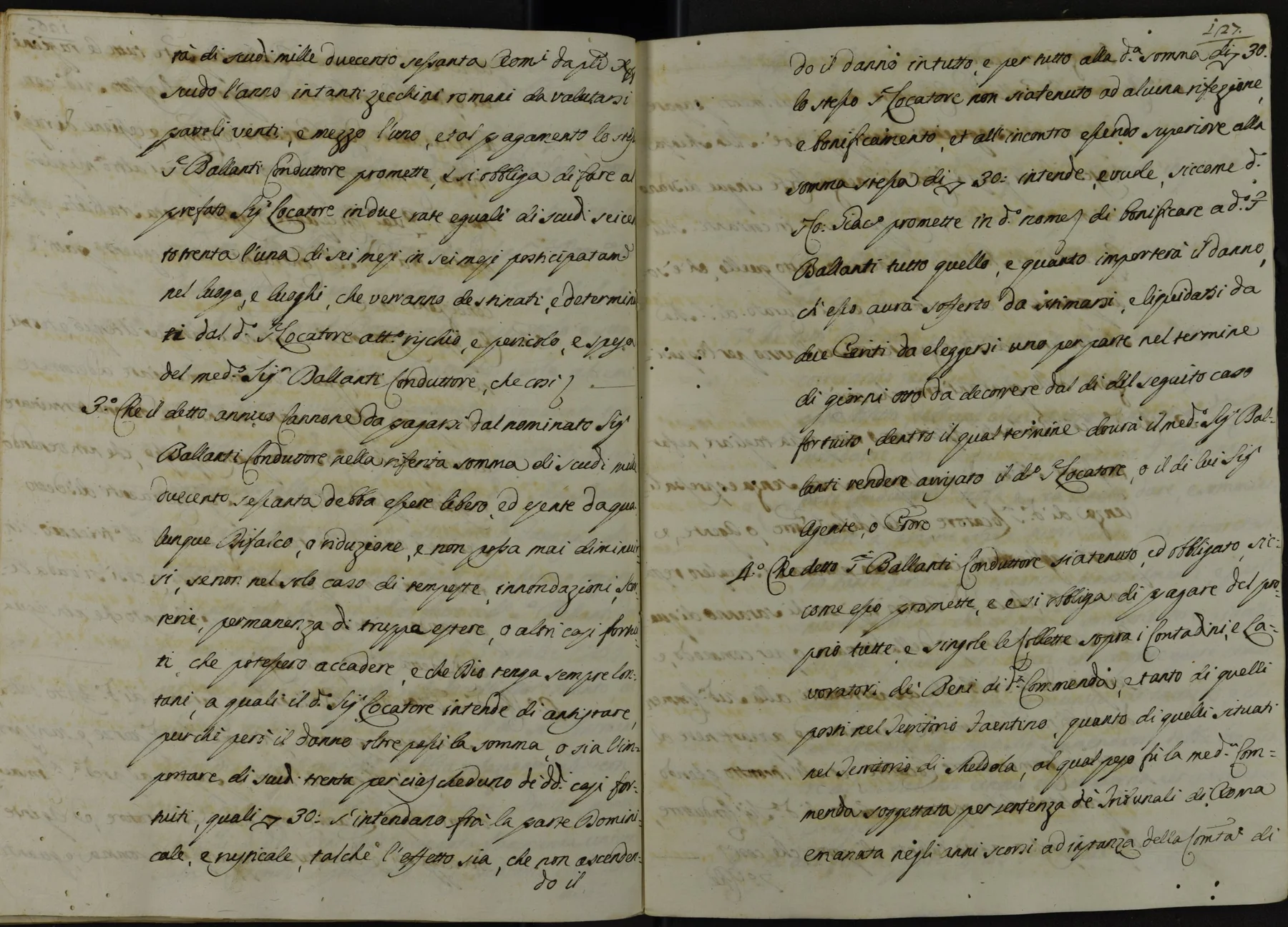
A lease of the commandery’s lands to its tenant, Ballanti: 1,260 scudi a year, paid in two equal instalments of 630 scudi. Bibliotheca, Valletta.
In his tenure of the land for five years, the commander was responsible for the upkeep of the land he was granted. It was Hospitaller policy to keep its landed estates in the best physical condition possible.
Two key factors made this necessary. It first demonstrated to the lands’ grantors that the lands were well-cared for and kept in excellent condition. These donors supported the Order and gave the Hospitallers access to these lands as a result.
Second, it was in the Order’s best interests to protect these territories since the income they generated helped to pay for all of the Order’s efforts, both military and religious, in the broadest sense. The nature of this meticulous maintenance was clearly demonstrated by the laws of the Order. Every priory’s (a collection of commanderies) commanders had their status checked on a regular basis.
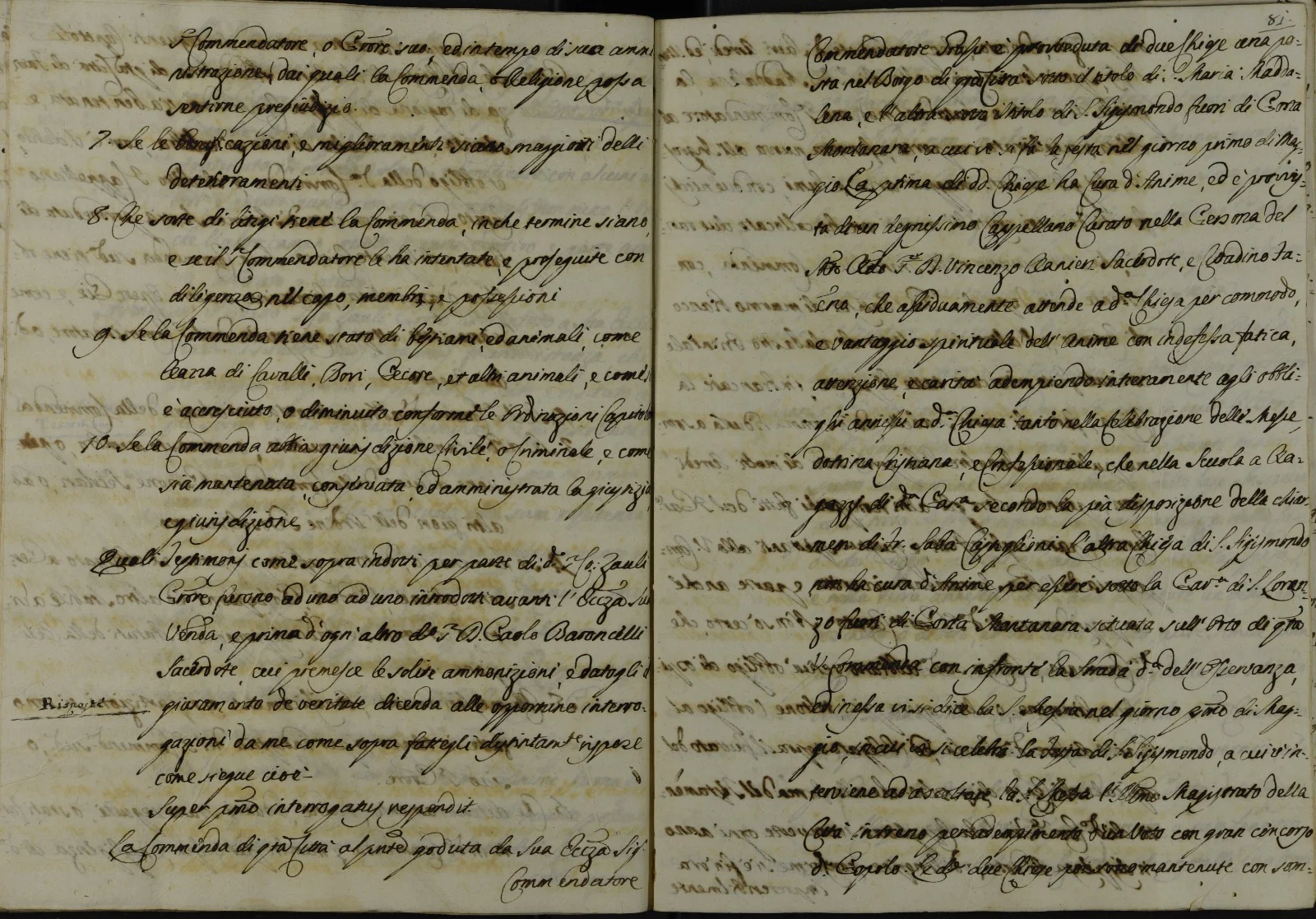
Witnesses questioned on the state of the commandery: whether improvements outweighed deterioration, how its livestock had fared and how its jurisdiction was kept. The right-hand page describes its two churches, Santa Maria Maddalena in the Borgo and San Sigismondo outside Porta Montanara. Bibliotheca, Valletta.
The Miglioramento of 1789 provides more detail on the services provided to the commandery. Such notes obviously include the act of service itself and the amount paid for such a service.
Have a look at part of the expenses transcribed from the Miglioramento document:
| Date | Service | Service provider | Amount paid |
|---|---|---|---|
| 18 December 1783 | Varnishing the church's new door | Giuseppe Costantini | 1 scudo, 20 baiocchi |
| 20 December 1783 | Several works on the church's door and windows | Antonio Boschi | 9 scudi, 85 baiocchi |
| 20 December 1783 | Several works on the church's walls, covering materials and workers | Giovanni Saviotti | 13 scudi, 65 baiocchi |
| 23 December 1783 | Works on the frame of the church's large window, covering materials and service | Gaetano Gordini Falegna | 7 scudi, 42 baiocchi |
In conclusion, the Miglioramento of 1789 demonstrates that budgeting and financial planning were essential aspects of administration long before the modern state. Through the careful recording of expenses and improvements, the Order of St John ensured that its properties remained well-maintained, its residents were provided for, and its estates continued to generate income.
These historical records offer us a valuable insight into the financial priorities and administrative practices of the eighteenth century, reminding us that, although the institutions and circumstances have changed, the need to manage resources responsibly has remained remarkably consistent over the past three centuries.
Manuscript scans provided by the National Library of Malta and licensed to Rebecca Scalvini Spiteri.